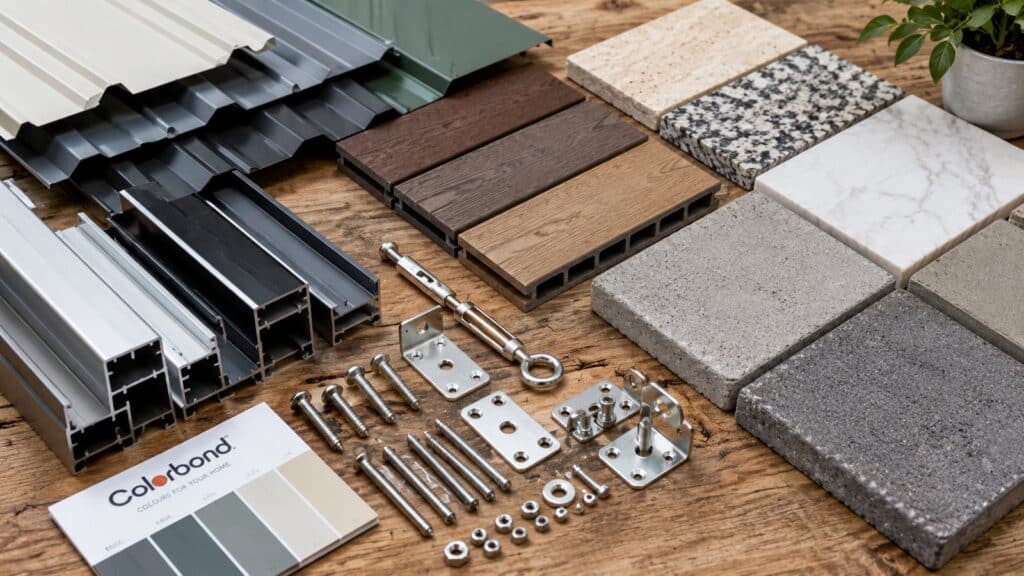
The materials that actually survive Gold Coast weather are Colorbond steel, marine-grade powder-coated aluminium, insulated roof panels, composite decking, sealed natural stone, 316 stainless steel fasteners and properly sealed concrete pavers. Everything else cuts corners somewhere and pays for it within a few years. If you have spent any time on the Gold Coast, you already know what salt air, summer humidity and a full day of Queensland sun can do to a cheap patio or deck. The right material list is the difference between a build that still looks great in twenty years and one that needs replacing in five.
How Salt Air, Humidity, and Queensland UV Actually Break Down Outdoor Materials
Three forces are working on every outdoor build from the day it goes up. Salt air, carried inland by sea breezes, eats untreated steel and dulls poor finishes. Humidity, sitting heavy through the summer months and the wettest months of February and March, swells timber, rots untreated joints and grows mould in shaded zones. UV from sunny days that stretch from September to November and right through the long summer months breaks down low-grade plastics, fades timber stains and cracks cheap sealants.
Understanding these three forces is the start of choosing materials that last. A builder who ignores them is gambling with your money.
Why Steel Grade And Powder Coating Quality Matter More Than Colour Choice
Most homeowners pick a Colorbond colour before they pick a steel grade. That is the wrong order. The grade of the steel and the quality of the powder coat finish decide how long the colour stays looking good. A premium Colorbond product with a proper warranty against fading and chalking is built for coastal conditions. A budget alternative looks fine on day one and tired by year five.
The same rule applies to aluminium. A marine-grade powder coat on structural aluminium is the standard for the Gold Coast. Lesser finishes start to chalk and fade within a few summers.
Budget Vs Professional Build: Where The Real Difference Sits
Marine-Grade Aluminium Framing As The Workhorse Of Gold Coast Patios
Marine-grade aluminium framing has become the workhorse of coastal Gold Coast patio and pergola builds for good reason. It does not rust. It does not need painting. It holds its powder-coated colour for decades. Compared with untreated steel, the maintenance is almost nothing. Compared with timber framing, the salt air resistance is in a different league.
For properties within a few kilometres of the beach, aluminium framing is usually the smart pick. For properties further inland, Colorbond steel framing is still a great option at a slightly lower cost.
Marine-grade aluminium framing
The default choice within a few kilometres of the beach. Higher upfront cost, but the maintenance is almost nothing.
- Does not rust, ever
- No painting required
- Holds powder-coated colour for decades
- Best pick for beachside suburbs
Colorbond steel framing
Still a great pick further inland. Slightly cheaper than aluminium, with premium Colorbond finishes built for the Queensland climate.
- Lower upfront cost than aluminium
- Premium fade and chalk warranties available
- Strong structural performance
- Best pick for inland Gold Coast suburbs
Colorbond, Zincalume, and Insulated Roof Panels Compared For Coastal Performance
The roof gets the hardest hit from the sun and rain, so the roofing material matters. A quick comparison of what we specify across the Gold Coast:
- Colorbond steel: tough, light, available in dozens of colours, holds up well to salt and UV when the right product is chosen, easy to integrate with the existing home roof
- Zincalume: a more economical option, naturally corrosion-resistant, sometimes a smart pick for sheds and carports where colour is not the priority
- Insulated roof panels: a sandwich of Colorbond top and bottom around a foam core, cuts the radiant heat, drops the noise of heavy summer rain, and turns the patio into a usable space on the hottest summer days
For most Gold Coast patios and outdoor entertaining areas, insulated roof panels are worth the extra spend. The comfort difference on a 35-degree summer afternoon is huge.
Composite Decking Vs Hardwood Timber: Real Lifespan In Salt Air
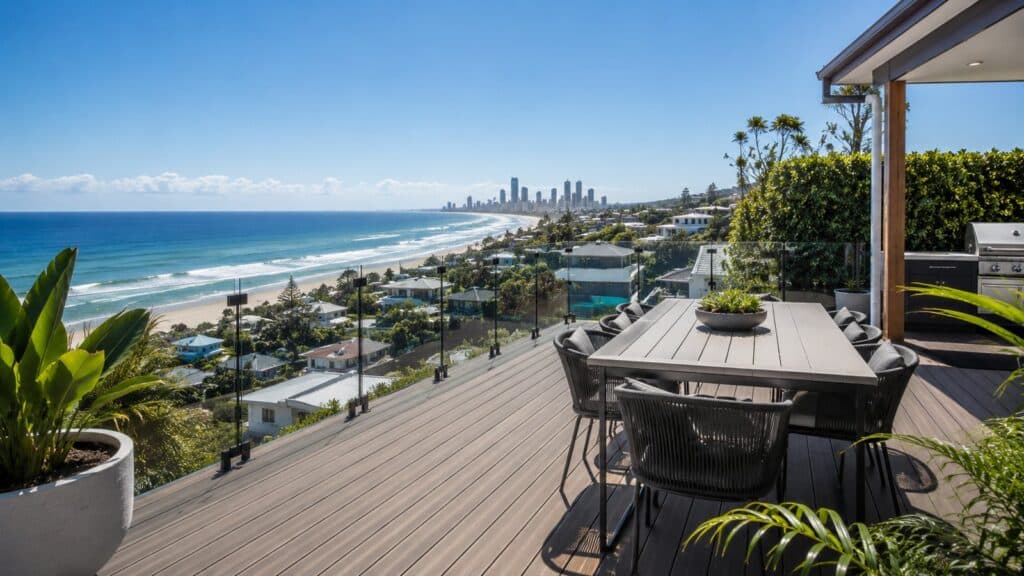
A timber deck on a sheltered inland block can last 25 years. The same timber deck, a few hundred metres from the beach, often needs major repairs in 8 to 12 years. Salt air, UV and humidity are brutal on hardwoods, even good ones like spotted gum and merbau.
Composite decking is the modern answer. It does not rot, does not splinter, does not need annual oiling, and holds its colour through years of UV. The upfront cost is higher than that of timber. The total cost over 25 years is usually lower. For families who do not want to spend a Saturday a year oiling the deck, composite makes a lot of sense.
That said, timber decks still earn their place on the Gold Coast when the look is right for the home and the owner is happy to maintain it.
Real Lifespan Of Common Deck Materials In Coastal Gold Coast Conditions
Years of useful life before major repair or replacement, based on coastal patterns within a few hundred metres of the beach.
The upfront cost of better materials is usually paid back twice over by the time you would have replaced the cheaper option.
Why Marine-Grade 316 Stainless Fasteners Are Non-Negotiable Near The Water
This is the detail that separates a long-lasting build from a short one, and it is the cheapest line item in the whole quote. Marine-grade 316 stainless steel fasteners and brackets are the standard for coastal Gold Coast builds. Standard galvanised fasteners corrode much faster in salt air, and the rust streaks down the posts within a year or two.
Mixing grades is worse than picking the wrong one. When two metals of different grades touch, you get galvanic corrosion at the joint. Every fastener, bracket and connector on the build should match the grade specified.
Sealed Natural Stone And Concrete Pavers: When They Earn Their Place
Sealed natural stone is a stunning surface for a patio floor or pool surround. Granite and travertine handle the Gold Coast climate well when sealed properly. The catch is the maintenance. A fresh seal every two to three years keeps them looking great. Skip the reseal and they stain.
Concrete pavers are the practical alternative. With a proper sealer, they handle heavy rain, salt and UV with almost no maintenance. They come in textured finishes that are cooler underfoot on hot summer days and slip-resistant around pools.
Glass Screens, Louvres, and Balustrade Fittings That Handle Salt Spray
Glass screens and louvres add huge visual appeal, but only if the fittings are right. The frames need to be marine-grade powder-coated aluminium. The fasteners need to be 316 stainless. The hinges and brackets on louvres need to be rated for salt exposure. A glass balustrade looks amazing on day one, whatever you use; only the right fittings keep it looking amazing five years in.
The Substructure Nobody Talks About: Joists, Brackets, and Bearers
The joists and bearers under a deck see no sun but plenty of humidity. They are part of the build that fails first when corners are cut. Treated timber, aluminium framing, or properly galvanised steel substructures are the only options near the coast. Putting a 25-year composite deck on a 5-year substructure is a waste of money.
We specify the substructure on every quote we write. If a builder leaves it vague, that is a warning sign.
Quick Quote Audit: What Your Builder’s Quote Should Spell Out
Run a tick through this list against any quote you have on the table. Missing items are where corners get cut.
Three or more boxes unticked? Push the builder for detail before signing anything.
Drainage, Ventilation, and Flashing Details That Protect Every Material Above Them
Good drainage and ventilation extend the life of every material in the build. Air movement under a deck stops moisture build-up that grows mould and rots framing. Proper gutters and downspouts move heavy summer rainfall away from posts and slabs. Flashings where the new patio meets the existing house roof stop water tracking into the wall cavity.
These are the boring details that decide whether your patio lasts 10 years or 30.
Maintenance Routines That Double The Life Of Any Gold Coast Outdoor Build
Even low-maintenance materials need a little love. A simple routine that adds years to any outdoor build:
- Hose the structure down with fresh water every few months to clear salt
- Check fasteners and brackets once a year for signs of corrosion
- Re-oil timber decks annually, re-seal stone pavers every two to three years
- Clean gutters and downspouts before the wet season
- Inspect flashings and seals after any major storm
Fifteen minutes a month protects a build that took weeks to construct.
Standards Your Gold Coast Build Should Meet
Outdoor building materials Gold Coast homeowners trust have to meet these standards. If your builder cannot reference them, push back.
Why Advanced Decking & Patios Specifies These Materials In Every Coastal Quote
Our team has spent over 17 years building patios, decks, pergolas and carports across the Gold Coast, Tweed Heads and Logan. Every quote we write specifies the material grade, the fastener grade, the framing system and the finish warranty. No vague language. No surprises at handover.
We build with Colorbond steel, marine-grade powder-coated aluminium, insulated roof panels, composite decking and 316 stainless fasteners as standard. Where a job calls for premium natural stone, hardwood timber or zincalume, we specify those too. Every option is matched to the property, the suburb and the way the family wants to use the space.
Outdoor Building Materials Gold Coast Wide: Suburbs We Cover
We build across the Gold Coast, Tweed Heads and Logan regions. If your suburb is not listed, give us a call. We almost certainly service it.
Our Simple 3-Step Process
- Free on-site consultation and quote: We visit the property, check the sun, the wind and the salt-spray direction, and write a free itemised quote with every material grade spelt out.
- Council approval and planning: Our team handles every council approval and engineering certificate end-to-end. No paperwork chasing.
- Build and workmanship warranty: We build the project to the documented standard with a written workmanship warranty and a finish that lasts in real Gold Coast weather.
Built For The Climate You Actually Live In
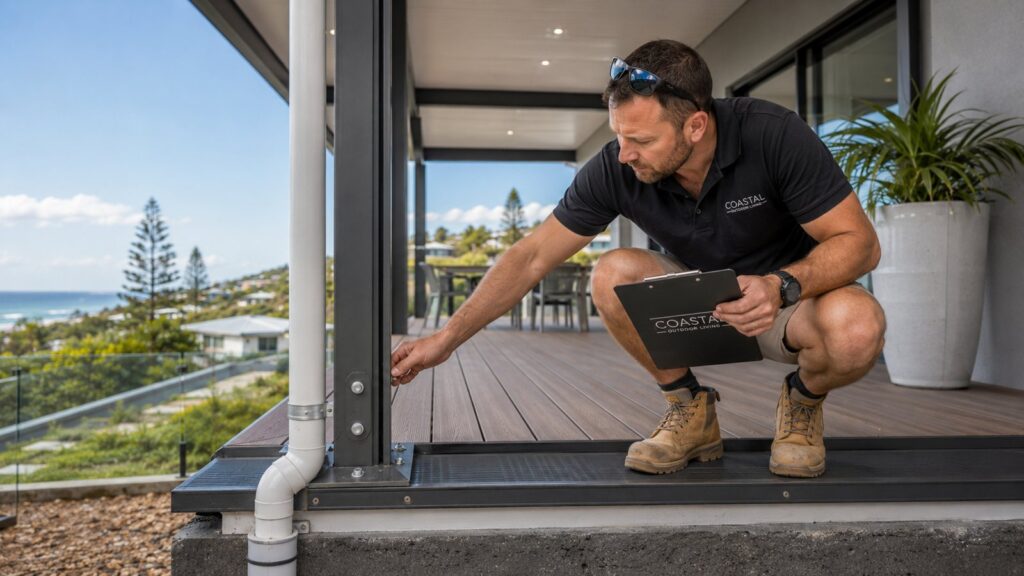
If you are planning a patio, deck, pergola, or carport on the Gold Coast, the material list matters more than the colour swatch. Get the grade right, get the fasteners right, and get the substructure right, and the build will still look great when the kids have moved out.
Advanced Decking & Patios is a QBCC licensed builder (Licence No. 15200654) and Master Builders Association member, with hundreds of five-star Google reviews from Gold Coast homeowners. We build for the salt air, the strong sun, the heavy summer rain, and the cyclonic wind ratings the Gold Coast actually demands.
Get in touch for a free consultation today. Call us, send an email, or use the contact form on the site. Our team will give you straight answers, no jargon, and a quote that lists every material by name.
Get The Right Outdoor Building Materials Gold Coast Homes Actually Need
Free on-site consultation. Itemised quote with every material grade named. No vague language, no pushy sales.
Outdoor Building Materials Gold Coast: Common Questions
How far inland does salt air actually affect outdoor building materials on the Gold Coast?
Salt drift can reach several kilometres inland on a strong easterly. Suburbs like Broadbeach, Mermaid, Palm Beach and Currumbin are full coastal exposure. Robina, Varsity Lakes and Nerang sit in the middle zone where marine-grade fittings are still smart. Once you are out past Mudgeeraba or Pacific Pines, standard galvanised hardware starts to perform reasonably, though we still recommend better grades for any long-life build.
How much more does a coastal-grade build cost than a standard one?
The premium for proper outdoor building materials on the Gold Coast usually sits between 8 and 15% of the total build. Marine-grade aluminium adds a bit more than premium Colorbond, and 316 stainless fasteners cost only a small amount more than galvanised. The payback comes when the build is still tight and looking sharp at year 15, instead of needing major repairs at year 7.
Is composite decking always better than timber on the Gold Coast?
Not always. Composite wins on lifespan, maintenance and total cost over 25 years, especially within a few hundred metres of the beach. Hardwood timber still wins on look, feel and warmth underfoot, and it pairs better with older Queenslander-style homes. If you are happy to oil it annually and reseal every few years, a quality hardwood deck still earns its place.
Do I need council approval for a patio, deck or carport on the Gold Coast?
Most attached patios, decks and carports on Gold Coast properties require either a building approval or a development application, depending on size, height and location relative to boundaries. We handle every council approval and engineering certificate end to end. You do not have to chase paperwork.
What is the difference between insulated roof panels and standard Colorbond sheeting?
Insulated roof panels are a sandwich of Colorbond top and bottom around a foam core. Standard sheeting is a single skin of steel. The insulated panel cuts radiant heat, drops the noise of heavy rain by a noticeable margin, and makes the patio usable on a 35-degree summer afternoon. The extra spend is one of the highest-value upgrades on the page.
How long does a Gold Coast patio or deck build usually take?
Once council approval is through, most patio and deck builds run between 2 and 4 weeks on site, depending on size, access and weather. The approval stage is usually the longer wait, generally 4 to 8 weeks. We give you a realistic timeline at the quote stage and stick to it.
What wind rating do I need for a Gold Coast patio?
Most of the Gold Coast falls within wind region B under AS 1170.2, with cyclonic considerations along the coast. Site-specific terrain, exposure and topography all factor in. Every structure we build is engineered to the right rating for your specific address, with the certificates to back it up.
Do you service areas outside the Gold Coast?
Yes. We build across the Gold Coast, Tweed Heads and Logan regions. If you are not sure whether we cover your suburb, send us a message or call. We almost certainly do.
Contact Us
Fill in the form below or call us on
0413 696 445 to get more information about our services.