
Patio guide, Gold Coast
An open patio is a roofed outdoor area with open sides that costs less and lets in the breeze, while an enclosed patio adds blinds, screens, polycarbonate, or glass so you can use it in more weather, at a higher price and with stricter building rules if it’s fully closed in. If storm season keeps chasing the family inside, or you want a backyard you can use year-round despite the summer heat, the right choice comes down to how you actually live, not which one looks best on Pinterest.
It’s one of the most common questions we hear at patio site visits, and after more than 17 years building outdoor living areas across the Gold Coast, our honest answer is usually somewhere in the middle.
The basics
What Counts as an Enclosed Patio and an Open Patio
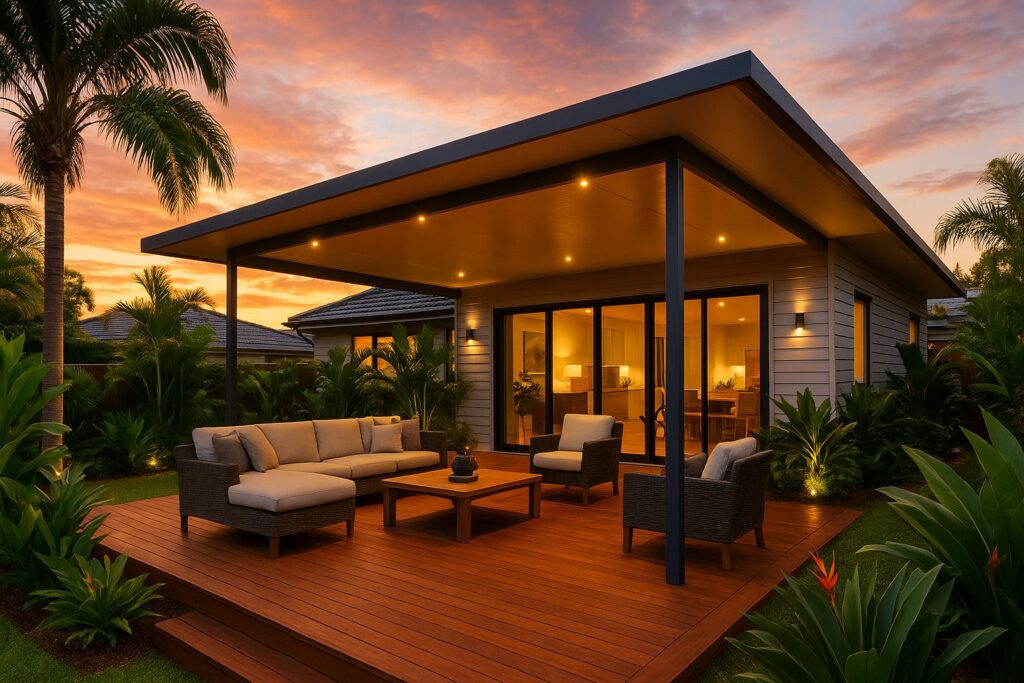
An open patio has a roof and posts but no walls. Think of a classic flat, gable or flyover patio over an alfresco area, with air moving straight through.
An enclosed patio keeps the roof but closes in some or all of the sides. That could be outdoor blinds you roll down when needed, fixed insect screens, polycarbonate panels, or glass panels and folding doors. Most Gold Coast projects sit somewhere in between. A patio with blinds on the western side and open everywhere else is a very common set-up here.
At a glance
| Open patio | Part-enclosed (blinds or screens) | Fully enclosed (glass or walls) | |
|---|---|---|---|
| Upfront cost | Lowest | Moderate | Highest |
| Airflow | Excellent | Good, roll up on nice days | Needs planning |
| Sideways rain | Gets in | Blocked when down | Blocked |
| Insects | No protection | Screens keep them out | Kept out |
| Summer heat | Breeze helps | Flexible | Can trap heat |
| Building rules | Approval for the roof | Blinds often exempt, screens and panels may not be | Can be treated as a habitable room |
Option 1
Pros and Cons of an Open Patio
The big wins with an open patio are cost and airflow. There’s less material and less labour, and in a sticky Gold Coast January the breeze moving through is worth a lot. It also feels like you’re actually outside, which is the whole point for many families.
The downside is that the weather comes in sideways. Wind-driven rain gets under the roof, the western sun can make it unbearable late in the afternoon, and the mozzies don’t need an invitation. You’ll also want furniture that can cope with getting wet.
Option 2
Pros and Cons of an Enclosed Patio
An enclosed patio earns its keep on the days an open one sits empty. Wet-season afternoons, windy days and buggy evenings stop being a problem. It can double as a kids’ play area, a home office or a second lounge, and your cushions last a lot longer.
The trade-off is price, and sometimes heat. Closing in the sides costs more, occasionally a lot more. Without good ventilation and an insulated roof, it can turn into a hot box. And fully enclosing it brings in tougher building requirements, which we’ll get to below.
Ways to close it in
Enclosure Options: Blinds, Screens, Polycarbonate and Glass
Each type of enclosure solves a different problem. Outdoor blinds are the most flexible and affordable place to start. They only protect you when they’re down, but on a nice day you just roll them up. Fixed insect screens keep the bugs out while still letting air through, which makes them popular around pools.
Polycarbonate panels let light in and keep rain out, but they can get hot without ventilation and may yellow over time under strong UV. Glass is the premium option. It lasts longer and insulates better, but it costs the most and needs good airflow planning for summer.
| Option | Best at | Watch for | Relative cost |
|---|---|---|---|
| Outdoor blinds | Flexible protection, rolled up on nice days | Only protect you when they’re down | $ |
| Fixed insect screens | Keeping bugs out while letting air through | Don’t stop heavy rain | $$ |
| Polycarbonate panels | Letting light in and keeping rain out | Heat build-up, yellowing under strong UV | $$$ |
| Glass panels and doors | Longest-lasting, best insulation | Highest cost, needs airflow planning | $$$$ |
Budget
Cost Comparison: Open Patio vs Enclosed Patio
Think of the open patio as your starting point, with any enclosure added on top. Independent 2026 cost guides report roughly these figures:
| Option | Indicative 2026 cost |
|---|---|
| Open attached patio, 20 to 35 m², Gold Coast | About $6,250 to $21,000 |
| Outdoor blinds, Queensland | About $800 to $2,500 per opening |
| Track-guided zip blinds or screens, Gold Coast | About $200 to $450 per m² |
| Blind enclosure on three sides (interstate guide) | About $5,000 to $14,000 |
| Fully enclosed glass room (interstate guide) | About $35,000 to $80,000+ |
These are published estimates, not our prices, and the interstate figures come from a South Australian guide, so Gold Coast prices may differ.
The length of open sides you want to close and the materials you choose will decide the real number.
Gold Coast climate
Heat, Airflow and the Gold Coast Climate
It catches people out, but on the Gold Coast a fully closed-in patio can end up hotter and less comfortable than an open one. Glass and polycarbonate let the sun in and then hold the heat, and without airflow the space can feel like a car parked in the sun.
So we usually plan for airflow first. That means an insulated roof to cut heat from above, ceiling fans to move humid air, blinds or doors that open right up on good days, and positioning that blocks the western sun but still catches the breeze.
The Gold Coast doesn’t have the long cold winters that make full enclosures so popular down south. Most of our year is warm, so the real comfort problems are heat, humidity, and afternoon storms. A design that handles those well will get used far more than a sealed glass room that’s too hot by mid-afternoon.
Weather protection
Protection from Storms, Rain and Insects
Storm season here brings heavy rain, hail, and strong winds, often late in the day. An open patio keeps off rain falling straight down, but wind-driven rain still gets in. Blinds or screens on the weather side make a big difference without closing the space in completely.
Walls don’t stop hail falling on the roof, though. Your roof sheets or insulated panels do that job, along with the fixings and the wind rating of the whole structure. The Gold Coast sits in wind region B1 under the current wind loading standard, AS/NZS 1170.2:2021, so patios here have to be designed to resist weakened tropical cyclones, and any blinds or panels should be suited to the wind too.
| Problem | What solves it | What doesn’t |
|---|---|---|
| Rain falling straight down | The patio roof | Walls |
| Wind-driven rain | Blinds or screens on the weather side | An open patio on its own |
| Hail | Roof sheets or insulated panels, fixings and wind rating | Walls |
| Insects | Fixed insect screens, keeping the breeze | Blinds rolled up |
| Western sun | Blinds on the western side, or positioning | A roof on its own |
If bugs are your main problem, fixed insect screens are often a better answer than glass, because you keep the breeze.
Approvals
Council Approval and Building Rules When You Enclose a Patio
Most roofed patios in Queensland need building approval, usually through a private certifier. Sun blinds are listed by some Queensland councils as minor attachments that are exempt from approval, so adding outdoor blinds generally doesn’t change the picture.
Permanent walls are a different story. Councils such as Logan list enclosing a patio, verandah or deck as work that needs building approval. Toowoomba Regional Council explains the difference clearly. A partly enclosed covered area is a non-habitable room and stays a class 10a structure, with fewer requirements. A fully enclosed one is treated as a habitable room, classed as 1a, with more requirements to meet.
| What you add | How it’s generally treated | What it means |
|---|---|---|
| Sun blinds | Listed by some Queensland councils as an exempt minor attachment | Generally doesn’t change the approval picture |
| Permanent walls on part of the patio | Listed by councils such as Logan as needing building approval | Partly enclosed areas stay class 10a, non-habitable |
| Fully enclosed patio | Treated as a habitable room, class 1a | More requirements to meet |
Based on information published by Logan City Council and Toowoomba Regional Council. Your certifier confirms what applies to your patio.
So if you might close it in one day, tell your builder now. It’s far easier to approve the right structure from the start. And if you’ve been reading about patio rules in NSW or the ACT, remember they don’t apply here.
The roof does the work
Insulated Roofing for Year-Round Comfort

Whichever way you go, the roof does most of the work. A single-skin steel roof shades you but gets hot in summer. An insulated panel roof cuts the heat coming through and dulls the noise of heavy rain, which matters even more if you close in the sides.
People often ask whether insulated panels are worth paying extra for. For a patio you’ll use every day, or one you might enclose later, we think they usually are.
| Single-skin steel roof | Insulated panel roof | |
|---|---|---|
| Shade | Yes | Yes |
| Summer heat | Gets hot and radiates down | Cuts the heat coming through |
| Rain noise | Louder | Dulled |
| If you enclose later | Heat builds up more | Much better suited |
Resale
Which Option Adds More Value to Your Home
There’s no single answer. Open patios appeal to buyers who love entertaining outdoors. A part-enclosed patio with good blinds gives the flexibility of both. What buyers definitely notice is quality: a patio that’s well built, has a good roof, and looks like it belongs to the house. They also notice one that leaks, rusts at the fixings, or looks like an afterthought.
Selling soon? Put your money into workmanship, not extra square metres.
Choosing the Right Option for How You Live
Start with how your weekends actually look. If you’ve got people over most Saturdays, airflow and room to move probably matter more than walls. If you want a quiet spot for the kids or a desk away from the house, closing it in starts to make sense. Then think about which side cops the afternoon sun, how bad the bugs get, and whether salt air from the beach or a canal will affect the materials.
Quick decision guide
| If this sounds like you | Lean towards |
|---|---|
| People over most Saturdays | Open patio with plenty of room and airflow |
| Western sun hits the patio in the afternoon | Blinds on the western side |
| Mozzies are the main problem | Fixed insect screens |
| You want a kids’ play area or home office | Part or full enclosure, with an insulated roof |
| You’re near the beach or a canal | Corrosion-resistant materials and coastal-rated fixings |
| You might enclose it later | Tell your builder now so the approval suits |
For many Gold Coast families, the sweet spot is an open, insulated patio with blinds on one or two sides. You get the breeze most of the year and shelter when you need it.
Our process
Working It Out Together
Free consultation
Still Torn Between the Two?
You don’t have to decide everything on day one. Plenty of homeowners start with an open, insulated patio and add blinds a summer or two later, once they know which corner the weather comes from. Dianne White had us design and build a carport and patio together, and her verdict was that they turned out exactly how she wanted. That’s what we’re aiming for, whichever way you go.
Call us on 0413 696 445, and we’ll come out for a free consultation. Ask about finance options if you’d like to spread the cost. Already made the call on your own patio? Tell us in the comments whether you went open or closed in, and whether you’d do it the same way again.
FAQs
Enclosed vs Open Patio FAQs
About Advanced Decking & Patios
Advanced Decking & Patios is a family-owned Gold Coast builder with more than 17 years’ experience building open, insulated and flyover patios, along with decks, carports and pergolas. We’re QBCC licensed (Licence No. 15200654), fully insured, Master Builders members, and rated 4.9 stars from 60 Google reviews.
Contact Us
Fill in the form below or call us on
0413 696 445 to get more information about our services.